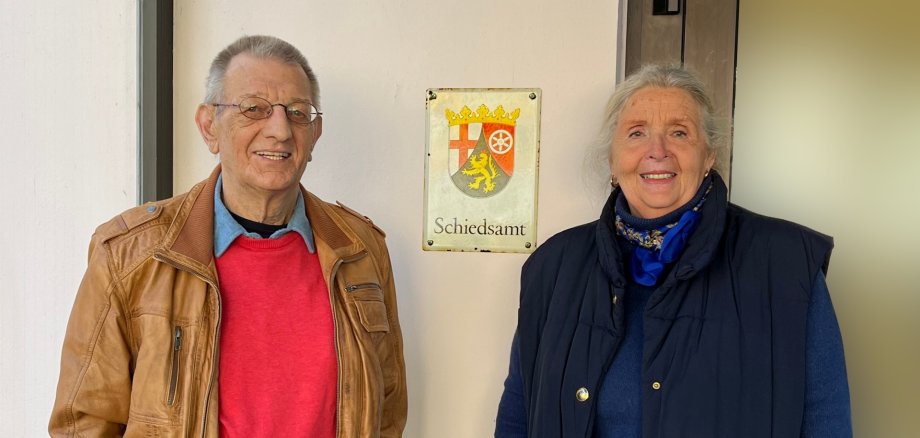
Increasingly, disputes are being brought before the courts without any prior attempt at amicable settlement. The arbitration office is a body that carries out precisely this out-of-court dispute resolution. In the town of Idar-Oberstein, the honorary office of arbitrator has been held by Angelika Kötz since February 2009, and Walter Mörtl has been her deputy since August 2025. The task of the two arbitrators is to conduct out-of-court arbitration proceedings in civil and criminal cases.
The main focus of the arbitrators' work is in the area of neighborhood disputes, but they can also be called in for certain criminal offenses. In some legal disputes, arbitration proceedings are even mandatory before a private lawsuit can be filed. The arbitration office is therefore an important instrument in the administration of justice, yet many citizens are unaware of it. In order to change this, Angelika Kötz and Walter Mörtl would like to present the work of the arbitrators to the public.
Arbitration offices are set up in Rhineland-Palatinate in association municipalities, municipalities not belonging to associations, large towns belonging to districts and towns not belonging to districts. In Idar-Oberstein, the arbitration office is part of the city administration's legal department. A clerk supports its work and is the contact person when the arbitrators do not have office hours. The arbitrators are honorary civil servants of the state, they are elected by the city council and appointed for five years by the director of the local court.
In proceedings, the arbitration office in whose district the defendant lives has local jurisdiction. The disputing parties can submit an application for arbitration there. Representation by a lawyer is not necessary and is not actually provided for. The parties are summoned to the arbitration hearing by the arbitrator, who conducts the hearing with the aim of reaching an amicable settlement between the parties. If this is not achieved or the other party to the dispute does not appear at the scheduled conciliation hearing, a certificate of unsuccessfulness is issued. The applicant can then appeal to the court.
The arbitrator for the town of Idar-Oberstein, Angelika Kötz, has been doing this job for 17 years, and Walter Mörtl has been her deputy for around nine months. "The plan is for there to be one arbitrator who usually handles the cases alone and a deputy who only acts when the arbitrator is absent. We have worked on the cases together as a team right from the start and have had good experiences," the two explain. The former secondary school teacher from Idar-Oberstein and the former German army soldier from Bavaria complement each other perfectly.
The two see the ability to listen - and to read between the lines - and then find an amicable solution together with the opposing parties as a prerequisite for the office of arbitrator. This is because, unlike a lawsuit in court, there is no judgment in arbitration proceedings. "We try to create an atmosphere of trust in a relaxed discussion and show the disputing parties ways to resolve the conflict amicably." If this is successful, the agreement is recorded in writing. This is a contract under private law that is valid for 30 years and can even be enforced in court. "But this rarely happens, as the parties agree voluntarily and have an interest in complying with the agreement."
This voluntary nature and the joint development of a solution is the great advantage of arbitration. "As there is no judgment, but rather an agreement, there are no winners and losers and both parties save face." This is particularly important in disputes between neighbors, some of which have dragged on for many years. "The parties are usually very relieved when an amicable solution is reached, because a dispute like this is also a huge burden." This is why the work of the arbitrators is often praised afterwards.
Although this is not free of charge, it is very inexpensive compared to legal proceedings. "The fee is 60 euros per case, regardless of how much time we have invested in it." There is also a lump sum for postage and similar expenses. Of the fee, 40 percent goes to the city, which provides the room and equipment for the arbitration office, while the rest remains with the arbitration office. The fee is only payable if arbitration proceedings are actually initiated. However, a meeting with the arbitrators is often enough for the parties to reach an agreement.
You can tell that Angelika Kötz and Walter Mörtl enjoy their work as arbitrators. "It's an interesting job with a wide range of topics and we have a lot of scope for decision-making," they both emphasize. It is also important for them to take advantage of the regular training opportunities and exchange ideas with colleagues. For example, there is a regulars' table for arbitrators in the Birkenfeld district.
- The arbitrators have office hours every Tuesday from 5 to 6 p.m. Their office is located at Georg-Maus-Straße 2, room II.019. During office hours, they can be contacted by telephone on 06781/64-1390 and by e-mail at schiedsamt@idar-oberstein.de. Outside office hours, you can contact the legal department of the city administration on 06781/64-1303. Further contact can be established here. The arbitrators of the city and all arbitrators of the entire district of Birkenfeld are looking forward to the active use of their services.