

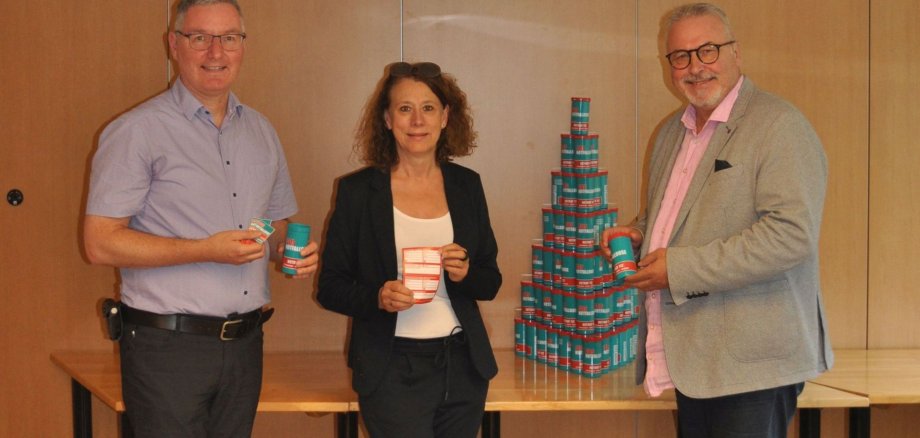
Not everyone is familiar with the “SOS emergency jar” yet: About the size of a jam jar, it contains a person’s most important health and contact information. The plastic container is kept in the refrigerator door. It comes with a sticker for the front door and one for the refrigerator—so that in an emergency, emergency responders can immediately see which medications a patient is taking, what pre-existing conditions or allergies they have, and who they should notify.
A concept for greater safety in everyday life that is as simple as it is well thought out deserves to be publicized as widely as possible. The Idar-Oberstein city administration, led by Mayor Frank Frühauf, agrees: That is why the city is currently distributing 2,000 emergency cans.
The eye-catching red-and-green cans were provided by the Bittmann Foundation. The Meisenheim-based nonprofit organization donated a total of 30,000 cans to the districts of Bad Kreuznach and Birkenfeld, as well as the Lauterecken-Wolfstein municipal association!
The city of Idar-Oberstein is now distributing the cans through counseling centers, home care services, and medical facilities, among other places—in short, wherever many older, sick, or vulnerable people naturally seek advice and support.
At the Caritasverband Rhein-Hunsrück-Nahe e.V., Eva Grosser from the city administration found another “grateful recipient”: Andreas Esch from the “Gemeindecaritas” specialized service at the Idar-Oberstein office is delighted that the employee from the city’s press office quickly packed a box containing 100 emergency food cans and even delivered it herself to the Caritas office on Friedrichstraße!
Harald Pillny explained what happens to the cans from there: “Many of our colleagues here work every day with particularly vulnerable people who are unable to manage their own lives,” said the Caritas office director. As examples, he cited outpatient care for people with intellectual or mental disabilities in their own homes and the care association.
“On top of that, a large proportion of the clients in question live alone and cannot rely on a supportive family network,” Pillny continued. If a medical emergency were to occur in their own homes—where every minute counts—such a small precautionary measure could actually make all the difference.”
“We’ll be all the more eager to ‘recommend’ the emergency can to those in our care—and help them fill in the necessary information,” Pillny emphasized. “Because one thing is clear: The more clearly the information is recorded, the more helpful it will be in an emergency.”
- For more information about the “SOS Emergency Can,” please contact Eva Grosser (Idar-Oberstein City Administration, Tel.: 06781/64-1242; Email: eva.grosser@idar-oberstein.de)
- For information about the local Caritas, contact Andreas Esch (Caritas Idar-Oberstein, 06781/50990-24; A.Esch@caritas-rhn.de) and visit www.caritas-rhn.de.