

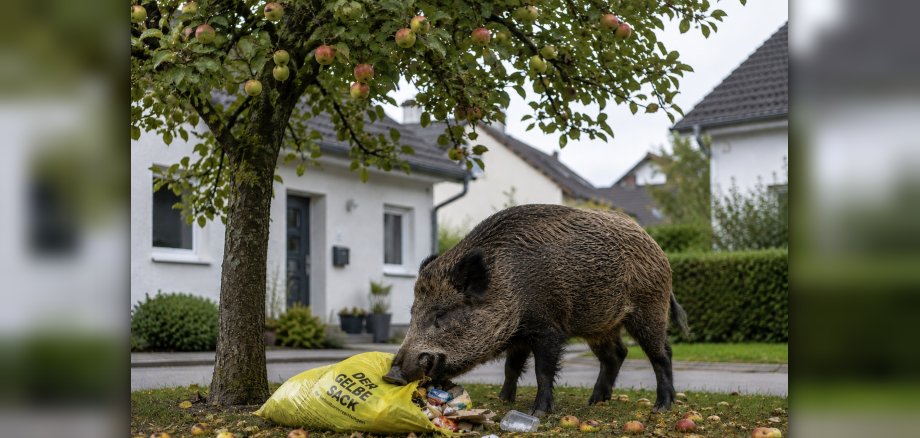
Recently, there has been a resurgence of problems with wild boars entering built-up areas and causing damage there. The city administration takes such reports seriously and investigates them; however, its ability to influence the wild boar population is limited. This is because measures to regulate the wild boar population are generally the responsibility of the respective hunting license holders. The city does, however, take note of such reports and repeatedly brings them to the attention of the responsible hunting leaseholders.
In this context, the city administration notes that property owners are generally responsible for taking appropriate measures to protect their properties. In addition, properties should be maintained, as far as possible, in such a way that they do not provide wild boars with additional food sources or places to take refuge. This can also help reduce the risk of encounters with wild boars in urban areas.
Simple measures can reduce risks
Due to prolonged heat and low rainfall, oak and beech trees are expected to produce significantly fewer acorns this year than in previous years. This could lead to wild boars venturing further into populated areas in search of alternative food sources, particularly in the fall and winter. To avoid attracting the animals further, property owners and residents can take the following measures in particular:
- Effectively Securing Property: A sturdy and sufficiently durable fence can make it much more difficult for wild boars to enter. Sturdy double-wire mesh fences, among other options, are suitable for this purpose.
- Do not leave food sources accessible: Trash, organic waste, or yellow bags should not be stored on the property where they are freely accessible.
- Do not leave pet food outside: Cat and dog food should not be left outside permanently when it is not feeding time.
- Remove fallen fruit promptly: If there are fruit trees on the property, fallen fruit should be picked up regularly and as soon as possible so that it does not become a food source for wild boars.
By taking these simple measures, citizens can help prevent wild boars from being unintentionally lured into residential areas and reduce potential conflicts between humans and animals. In addition, this can also help prevent the spread of African swine fever (ASF). This is because discarded food and food scraps—especially those accessible to wild boars—play a significant role in this regard. Consistently avoiding food sources in residential areas is therefore of great importance both in terms of the wild boar problem and the prevention of ASF.