
Presentation on the "Principle of Neutrality" in the Context of Associations and Public Administration
Category: Lecture / Reading
Presentation on the "Principle of Neutrality" in the Context of Associations and Public Administration
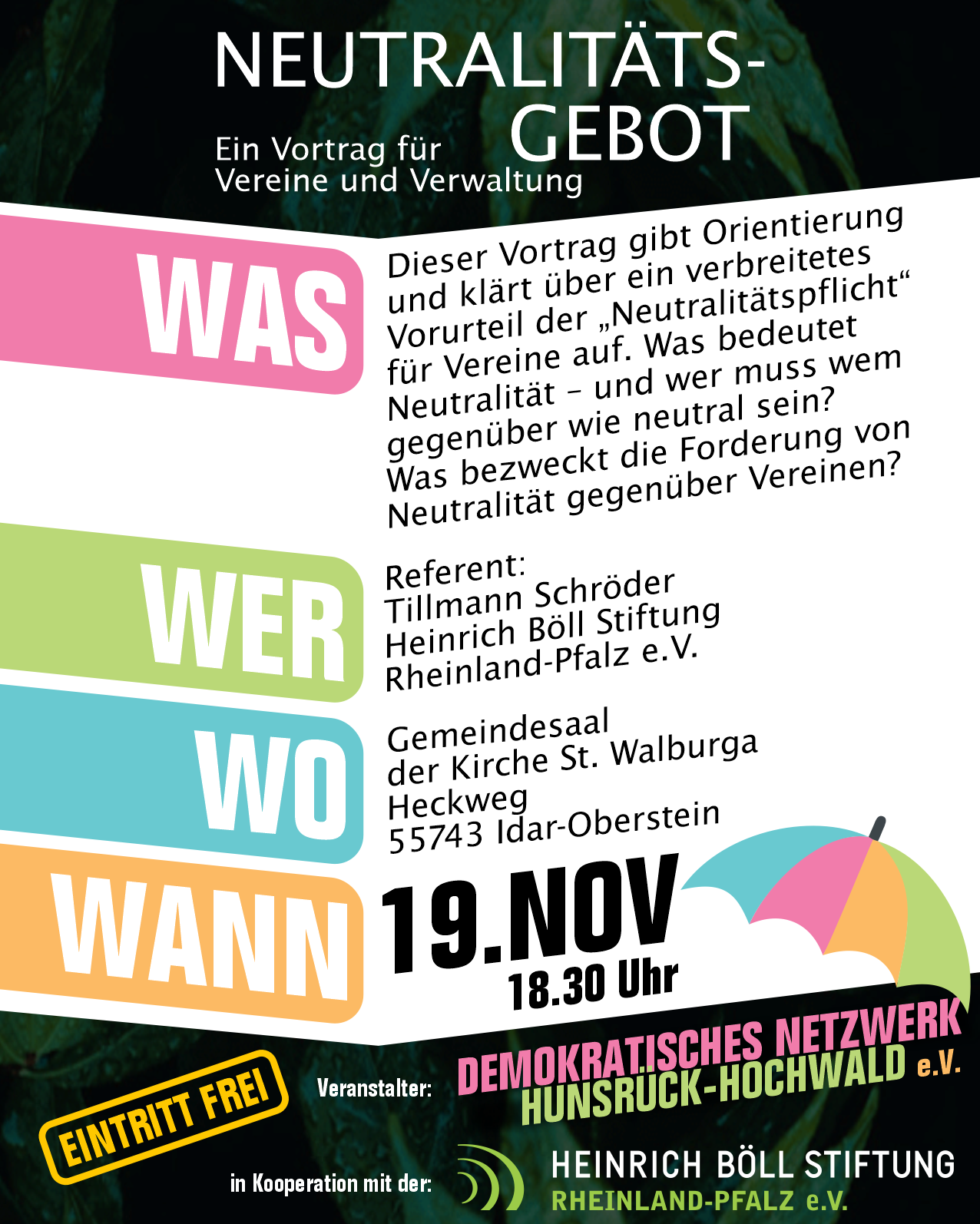
On November 19, 2026, at 6:30 p.m., a lecture on the principle of neutrality will take place in the parish hall of St. Walburga Church in Idar-Oberstein. Admission is free; registration is not required.
The association Demokratisches Netzwerk Hunsrück-Hochwald e. V., in cooperation with the Heinrich Böll Foundation Rhineland-Palatinate e.V., invites all interested individuals and active members of associations and institutions to this lecture. Tillmann Schröder will speak on the topic. The event will take place in the parish hall of St. Walburga Church, Heckweg 9, 55743 Idar-Oberstein. Following the lecture, there will be an opportunity to ask individual questions.
Time and again, political parties in particular demand that civil society remain politically neutral. In this context, associations are even threatened with the revocation of their nonprofit status. But does the frequently cited principle of neutrality even exist? And what is meant by neutrality?
Since completing his studies in political science in Mainz and Darmstadt, speaker Tillmann Schröder has focused his work on the role of civil society and its relationship to the state and political parties in modern political systems.
The Democratic Network’s presentation aims to allay the fears of those in leadership roles and encourage them. The central question is: How can associations and other civil society activists visibly take a stand for the democratic constitutional order in their everyday lives? The organizer’s message: A democratic society is not neutral. This is because civic engagement and civil society require human dignity, fundamental rights, and diversity as the indispensable foundation for peaceful coexistence. According to the organizer, neutrality can never be the answer when fundamental rights come under pressure.
This orientation is particularly important for associations. They organize, shape, and promote activities and the coexistence of their members at the local, state, and federal levels. At the same time, they have an impact on society beyond the boundaries of their own associations. Thanks to these associations, people experience a sense of community in sports, culture, music, education, animal welfare, and many other areas. Young and old alike experience democratic processes on a daily basis within the structures of these associations. It is not uncommon for children and young people to experience there, for the first time, that they can make a difference themselves through participation.
As a result, associations in Germany are firmly rooted in democratic society. As part of civil society, they enjoy a high level of esteem among the general public and across broad segments of the political spectrum. The high status of associations is reflected, among other things, in the special laws governing them. For this reason, the lecture will also address association law. Furthermore, it will provide insight into the role of the administration. While it should and must cooperate with civil society, it is repeatedly confronted with demands for neutrality in this context.