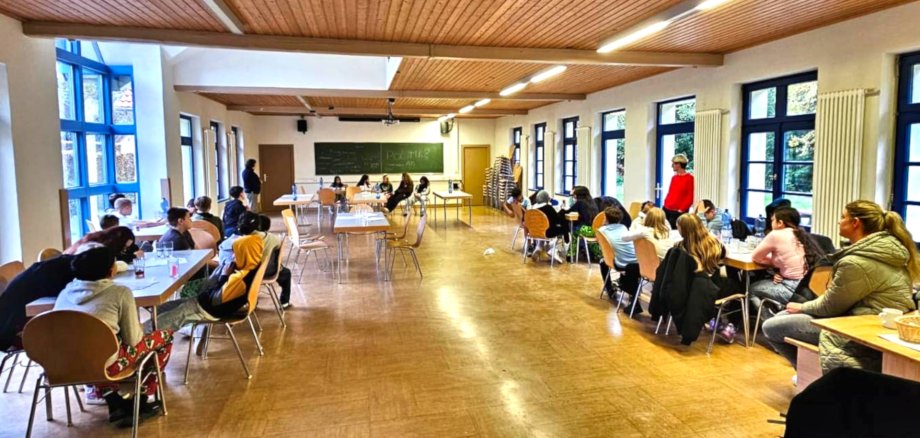
Over the winter, Year 6 and Year 10a classes at Realschule plus Idar-Oberstein, Rostocker Straße, each carried out three-day educational projects at the Birkenfeld district youth recreation center in Hattgenstein. Although the projects were adapted according to age, the program was largely identical and focused on democratic decision-making and interaction. Several program points were worked on in each case.
In the "Democracity" simulation game, the students were faced with the task of locating a selection of different institutions in a fictitious city on a well-founded basis. Among other things, they had to negotiate which institutions would actually be realized, as the city - as in real life - naturally only had a limited budget. A suitable location also had to be found for the selected institutions. The students quickly agreed that the waste incineration plant did not belong in the city center any more than a daycare center on a busy arterial road. But is the better location for a representation of the European Union the outskirts of the city - where one could work undisturbed - or rather close to the center - to bring Europe into the hearts of the people by making European policy in the heart of the city? Questions like these gave rise to lively discussions and new insights.
In a further simulation game, the microcosm was scaled down even further and at the same time made more comprehensible for the pupils: instead of negotiating within the framework of an entire city, various interest groups now negotiated within the framework of a fictitious school. The focus of the negotiations was to find a new use for a room in the school building. Space is always a rare commodity in educational institutions, which is why various groups from the student body, teaching staff and non-teaching staff were highly engaged in the discussions. The various proposals for use were then put to the vote. This resulted in a compromise in the 10a project, according to which the students can use the room alternately as a quiet retreat during breaks and as a band rehearsal room in the afternoon. A great result for everyone involved, even for the interest groups that lost out in the discussion.
In the final content block, the learning group dealt with the phenomena of fake news and hate speech, which are becoming increasingly prevalent on the internet. Their spread was underlined by the many observations and sometimes personal experiences that the children and young people shared in the circle of chairs. In the subsequent input on dealing with fake news, it became clear that simply ignoring fakes is not enough! Factual counter-speech and corrections are needed to influence the AI algorithm. And if you don't want to expose yourself with your own post, you can achieve the same effect by supporting existing posts, for example by sharing them or giving them likes.
Despite the educational value of the projects, leisure activities were not neglected either. Hikes and team sports in the outdoor area, games evenings with cards, board games and action games as well as communal barbecues - despite the wintry temperatures during the 10a project phase - ensured that time passed in a flash.
Pupils and teachers would like to thank Professor Tomke Lask and Gerold Lofi for their professional guidance during the three days. We would also like to thank the Local Partnership for Democracy in the Birkenfeld district, which supported the project financially with funds from the federal "Demokratie Leben!" program of the Federal Ministry of Education, Family Affairs, Senior Citizens, Women and Youth. Finally, a big thank you to the team at the Hattgenstein Youth Recreation Center, who listened to all concerns and took particular care of the physical well-being of all participants.