"KuLaDig-RLP" is the abbreviation for the state-wide project "Digital recording and presentation of cultural landscapes in Rhineland-Palatinate". The model and funding project is being carried out by the University of Koblenz-Landau with the support of SGD Süd and funded by the Rhineland-Palatinate Ministry of the Interior and the university. The aim of the project is to systematically record the cultural diversity in Rhineland-Palatinate and make it visible through digital and multimedia processing of selected objects.
Isabelle Hahn from the tourist information office initiated the application for the project with the theme "Gemstone and jewelry metropolis Idar-Oberstein". As part of the project, the city of Idar-Oberstein was supported in digitally recording and communicating its identity-forming places and intangible cultural assets. Under the general theme of "Development through the centuries to a gemstone and jewelry metropolis", the "KuLaDig-RLP" homepage features a local contribution on the history of Idar-Oberstein as well as individual contributions on gemstone processing and the jewelry industry, the industrial hall, the German Gemstone Museum, the German Mineral Museum, the Steinkaulenberg gemstone mines, the historic Weiherschleife and the Jakob Bengel industrial monument.
In collaboration with students from the University of Koblenz, but above all with the help of people involved in several places of interest and the city archivist Dr. Svenja Müller, a historical local contribution and eight sub-objects were created. Enriched by numerous historical photos, videos with contemporary witnesses and experts as well as a virtual tour through the Bengel industrial monument, professions and social history relating to the jewelry and gemstone industry are brought back to life. In this context, the Idar Industrial Hall, a flagship of the gemstone and jewelry industry and for a long time one of the town's main attractions, also plays a central role. In addition, the interesting articles on the town's history by town archivist Dr. Svenja Müller make a significant contribution to the successful presentation. These shed light on the town from archaeological finds to the settlement, the Oldenburg rule, the economic rise of the region and on to the present day.
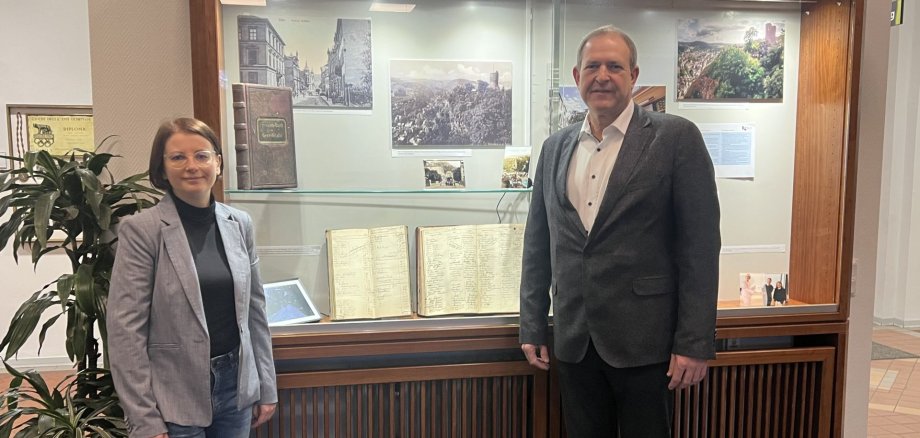
In order to get a wider public interested in the project, city archivist Müller has now created a display case in the foyer of the city administration. In addition to information about the KuLaDig project, an original "book of foreigners between 1909 and 1917" from the Idar commercial hall is on display, with entries from May 1912, including those of "marriageable ladies" from Gimbweiler, Simmern and Wolfersweiler. Next to it is a "Diary of the Trade Hall", in which the goods sold between 1910 and 1912 are documented. The presentation is supplemented by historical photos and current photos of Idar and Oberstein as well as a film from the 1920s.
Together with city archivist Dr. Svenja Müller, Lord Mayor Frank Frühauf took a look at the information in the display case and was pleased with "how prominently Idar-Oberstein is represented on KuLaDig". He describes it as "a prime example of how a city has digitally processed its industrial history and geographical features".
The articles on Idar-Oberstein are available at https://t1p.de/2akid.