

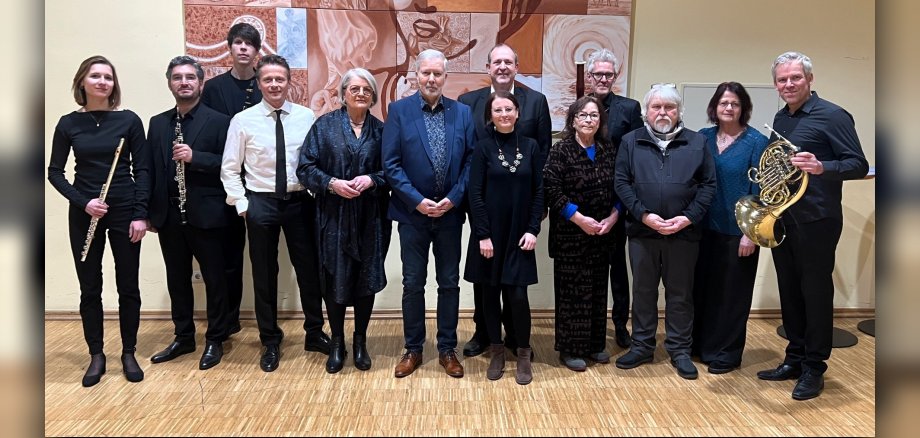
This year's memorial service for the victims of National Socialism took place last Tuesday. More than 300 visitors attended the event organized by the city of Idar-Oberstein and the Shalom Association in the municipal theater.
Lord Mayor Frank Frühauf welcomed the guests as well as actor Roman Knižka and the Opus 45 wind ensemble, who were performing their program 'That a good Germany may flourish ...' for the fourth time at the commemorative event in Idar-Oberstein. He thanked the Schalom chairman Axel Redmer and city archivist Dr. Svenja Müller, who had made the regional part of the program possible with their research. Mayor Frühauf emphasized that the Auschwitz concentration camp, which was liberated by the Red Army on 27 January 1945, stands as a memorial to the horrors of Nazi rule. "However, remembering this must not just be about looking back, but must be an active part of our culture." Above all, it is important to pass on the memory of what happened to the younger generation. "Because we have a responsibility to educate the next generation, with the aim of ensuring that this horror is never repeated."
Shalom chairman Axel Redmer pointed out that the city and his association have been jointly organizing this commemorative event since 2005. "This has done a lot for sensible educational work here locally." Redmer emphasized that the evening commemorative event is always supplemented by school events to raise young people's awareness of the topic. This is also urgently needed, as current events in the USA are showing how quickly a democracy can be destroyed.
Roman Knižka and Opus 45 then transported the audience back to the post-war period with their program 'Dass ein gutes Deutschland blühe ...'. Texts and music told of life in the years 1945 to 1949 - of ruins and hunger winters, displaced persons and returnees, of everyday violence and new cultural beginnings. In an intense performance, Knižka recited texts by the American war correspondent Margaret Bourke-White, from the notes of a Red Army soldier, from articles by the journalist Ruth Andreas-Friedrich and from notes on the Nuremberg trials. He played a scene from the anti-war film 'Die Brücke', sang Günter Neumann's 'Insulanerlied' and danced to 'Bei mir bist du schön', the hit song of 1948.
As a regional contribution, Knižka quoted from the diaries of Prof. Max Huber, who was the second alderman of the city of Idar-Oberstein from 1946 to 1949. His grandson Dedo Töpfer had left Huber's memoirs to the town archives. He also took the opportunity to come in person from Unterhaching to Idar-Oberstein for the commemorative event. An article by Werner Bohrer in the 'Idar-Obersteiner Nachrichten' newspaper in 1955 made it clear how strongly the Nazi regime was still anchored in some people's minds many years after the end of the war. The former local NSDAP propaganda leader reported on the alleged murder of 40 people in the Algenrodt internment camp. The event was fictitious, but the article is still being circulated in historical revisionist circles to this day.
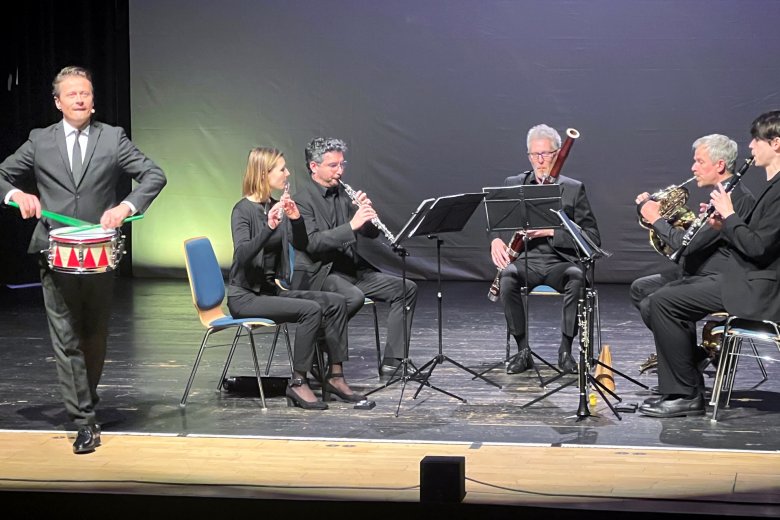
The wind quintet's performance was no less intense and high-class than Knižka's. It performed Beethoven's 'Allegretto', the song 'Hänschen klein' - title music to the film 'Steiner - Das Eiserne Kreuz', Richard Strauss' 'Andante', Artur Beul's 'Nach Regen scheint Sonne', Glenn Miller's 'Moonlight Serenade' and many other pieces, thus presenting a musical portrait of this era.
The audience honored the outstanding performance of the actors and musicians with a long standing ovation. Their haunting performance will certainly have a lasting effect. Benjamin Comparot, horn player with Opus 45, took the opportunity to draw the audience's attention to the new program that the ensemble is currently developing. The true crime format deals with four murders, including that of the Russian journalist Anna Politkovskaya, who was shot dead in Moscow on October 7, 2006. Opus 45 would like to perform this program in Idar-Oberstein.